A crane can have enough capacity, a project can have enough manpower, and materials can still sit idle.
The problem is often material flow in construction, how materials move from delivery and storage to the point where they are actually needed. When that movement is poorly planned, cranes wait, workers wait, access routes become congested, and planned activities start slipping.
For EPC contractors and site teams, improving material flow is not simply about moving materials faster. It is about moving the right material, to the right location, at the right time.
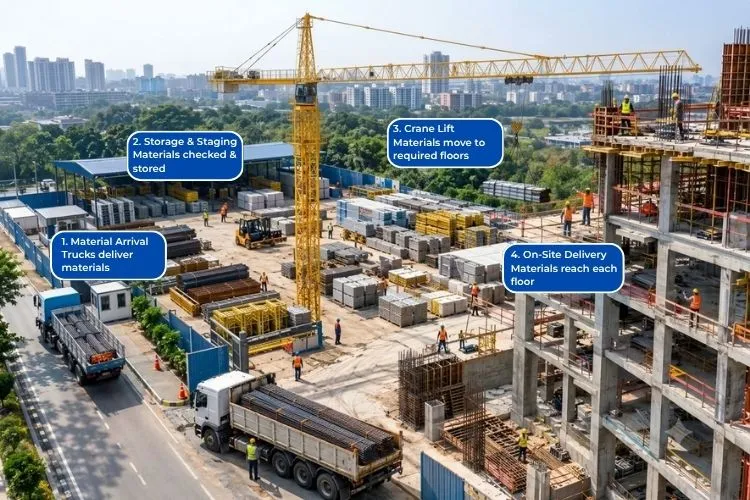
Material flow in construction is the movement of materials through different stages of a project from receiving and storage to staging, lifting, transportation and final installation.
On a high-rise project, a typical flow may look like:
Delivery → Storage → Staging → Vertical lifting → Floor/Work zone → Installation
Every additional movement, unnecessary relocation or waiting point adds time and handling effort.
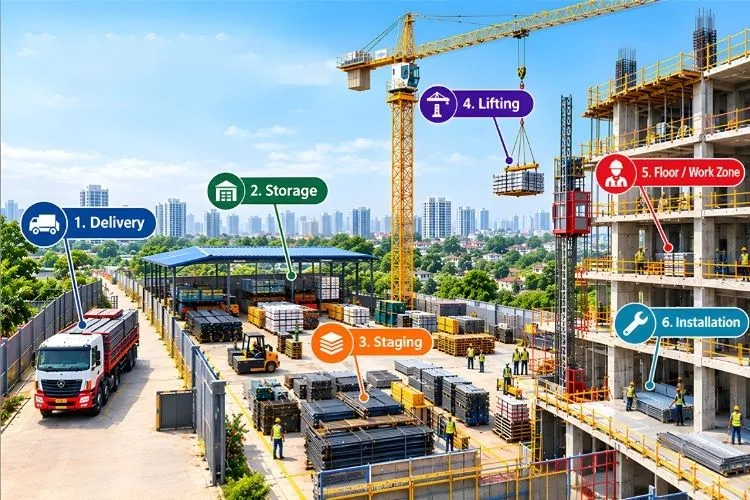
This is why material flow should be considered during construction logistics planning, rather than only after site operations begin.
Material movement problems are rarely caused by one major issue. They usually build up through small inefficiencies.
If materials are delivered to whatever space is available rather than a planned storage or staging area, workers may have to move them several times before installation.
That creates double handling and increases dependence on lifting equipment.
A material delivery is useful only when the project can receive, store and move it efficiently.
If the unloading area is occupied or the required lifting equipment is busy, the delivery can become another source of site congestion.
On a high-rise project, several activities may depend on the same tower crane. Structural materials, reinforcement, formwork, MEP components and other loads can compete for lifting time.
This is where tower crane productivity becomes closely connected to the wider material flow of the project.
The objective is not simply to have a crane operating continuously. The objective is to ensure that its available lifting time supports planned construction activities.
For projects where lifting demand changes significantly between phases, selecting the appropriate crane arrangement is important. Orange Machinetech, for example, provides tower cranes for different construction applications and configurations.
Good construction site logistics begins with the physical arrangement of the site.
Before work starts, project teams should consider:
The objective is to reduce unnecessary horizontal movement before the material even reaches the crane or hoist.
A useful question for planners is:
How many times does this material need to be handled before it is installed?
If the answer is three or four times, there may be an opportunity to redesign the flow.
As buildings become taller, horizontal site logistics are only part of the problem. Materials and people must also move vertically through increasingly constrained work areas.
This is where equipment such as tower cranes and passenger hoists becomes part of the site's overall material movement strategy.
A passenger hoist can support the vertical movement of workers and suitable materials between levels, reducing dependence on other site access arrangements. Orange Machinetech offers passenger hoists for high-rise construction, including 1–3.5 tonne options.
The important point is that lifting equipment should not be planned independently from the rest of the site.
Its capacity, location, operating schedule and access should correspond with the construction sequence.
Crane utilization is often viewed as a crane-specific metric, but the reasons behind low utilization can originate elsewhere.
For example, a crane may be available but unable to lift because:
In these situations, simply increasing crane operating hours will not solve the underlying problem.
The better approach is to coordinate material preparation, delivery timing, staging and lifting schedules.
EPC teams can make material flow easier to manage by mapping the movement of major materials before execution.
For each critical material, identify:
Where is the material coming from?
Where will the vehicle unload?
Where will the material remain before use?
will it be prepared for lifting or installation?
Will it move by tower crane, passenger hoist, other lifting equipment or manual handling?
Where does the material actually need to reach?
When does the work team need it?
This simple flow map can expose unnecessary movements and potential bottlenecks before they affect the construction schedule.
More equipment is not always the answer.
Before adding another crane, hoist or handling system, review the existing process.
Avoid treating procurement and site delivery as separate activities. Delivery timing should reflect when the material can actually be received, stored and installed.
A temporary staging area near the lifting point can reduce repeated handling, provided it does not obstruct access or create safety risks.
Not every load has the same impact on the schedule. Critical structural or installation materials should be coordinated with the lifting plan so they do not compete unnecessarily with lower-priority movements.
A logistics plan that works during the structural phase may not work during façade, MEP or finishing activities.
The location of storage, access routes and lifting demand can change significantly as the building progresses.
For complex high-rise projects, this is also why tower crane planning needs to consider the construction sequence rather than treating crane selection as a one-time decision.
Before starting a major construction phase, ask:
If several answers are unclear, the issue may not be equipment capacity. It may be the flow of materials around the site.
Material flow in construction is ultimately a coordination problem.
A well-planned crane can still lose productive time if materials are not ready. A well-organized storage area can still create delays if the lifting route is poorly planned. And increasing equipment capacity will not necessarily solve a bottleneck created by delivery timing or site congestion.
For EPC contractors, the better approach is to connect construction site logistics, material handling, lifting equipment and the construction sequenceinto one plan.
When materials spend less time waiting, travelling unnecessarily or being handled repeatedly, the entire site has a better chance of maintaining its planned production rhythm.