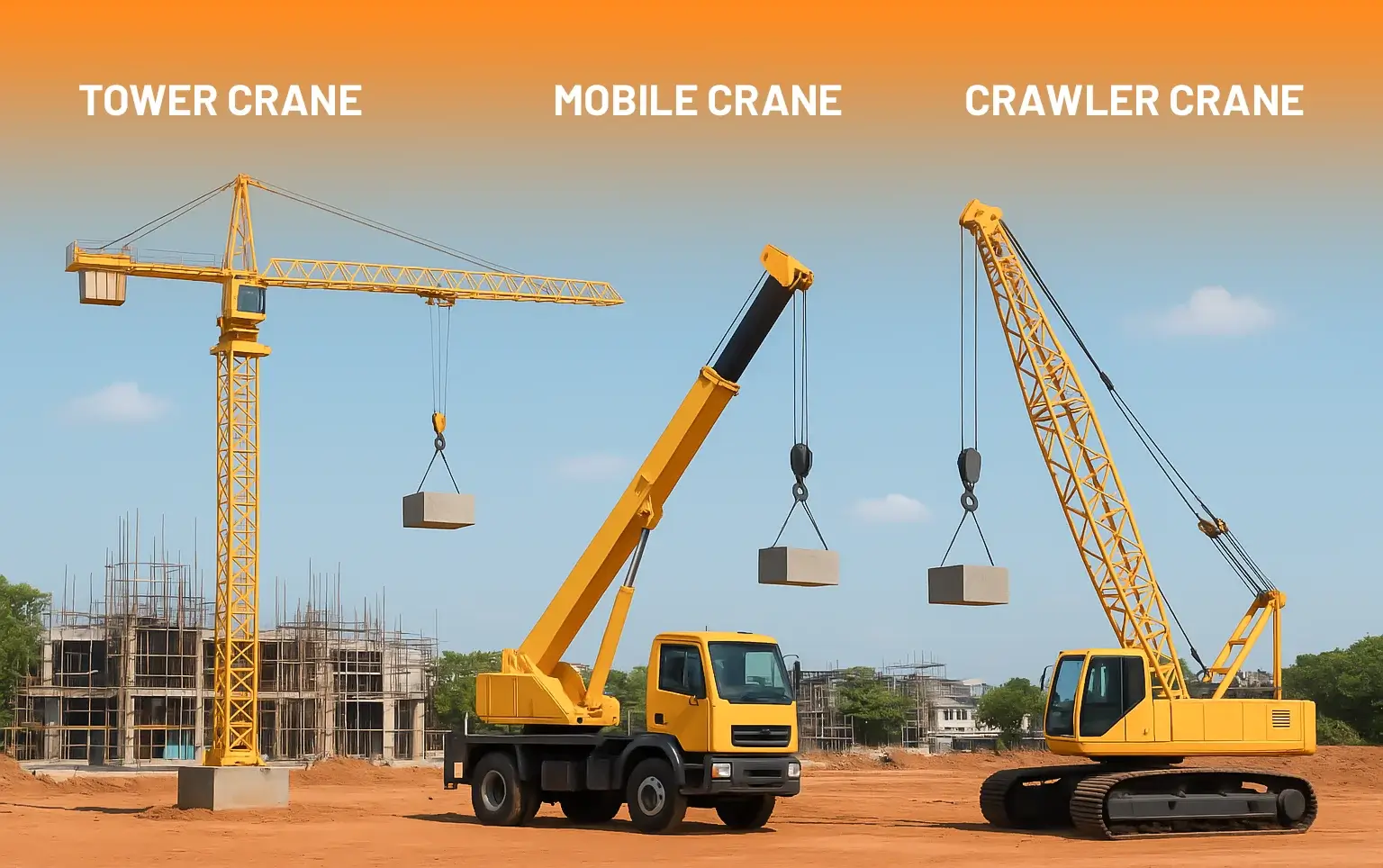
Cranes for construction are the common denominator across all modern Indian jobsites, from dense inner city or urban high-rises to enormous highway or metro rail developments. If you are a contractor, rental organization, or procurement lead, choosing the right machine for your specific task is often the key decision that can take you from fluid forward progress to costly downtime.
As a contractor or materials management professional, our guide will present construction crane types, applications, operational areas of strengths, areas to narrow down capacity and configuration, situations to consider a purchased or used crane for sale, and what to review before you buy crane solutions that are aligned with your scope, budget, and safety parameters.
India’s construction pipeline keeps expanding. That means more bids, tighter timelines, and tougher safety expectations. You don’t have time to parse manufacturer brochures or generic lists; you need a concise, expert view that helps you act. Below, we map cranes for construction to real project use cases, then show you how to choose with confidence and justify your decision internally.
Before we zoom in, here’s the big picture of construction crane types you’ll actually use and why each matters.
When your skyline is the constraint, a tower crane for sale is usually the answer. Fixed or climbing, flat-top or luffing-jib, tower cranes deliver:
Use when: You’re building tall (residential, commercial, mixed-use), or you need consistent high-rise logistics with minimal ground disruption.
Shortlist check: Tip load vs radius, jib length, tie-in plan, power availability, and site wind profile. Plan for SLI (Safe Load Indicator) integration and consider ACD (Anti-Collision Device) if you’ll have multiple cranes or tight perimeters.
Need quick mobilization, multiple small lifts across a large site, or frequent job-to-job movement? Start with mobile cranes.
Use when: Your lifts are spread out or one-off, or when street access and the ability to demobilize fast are critical.
Buying lens: Capacity charts at working radius, axle configuration and road permits, outrigger footprint, and telematics. We’ll cover mobile crane price India factors a little later so you can budget smarter.
A crawler crane for sale is your go-to for ground-bearing stability and serious capacity without outriggers.
Use when: You need heavy picks and repositioning without road access or when soil conditions demand wide tracks and low ground pressure.
Shortlist check: Track width and ground pressure, assembly logistics, transport planning, and boom/jib combinations.
Choosing cranes for construction is less about the maximum number on a datasheet and more about the heaviest realistic pick at the actual working radius, repeated across typical lift cycles.
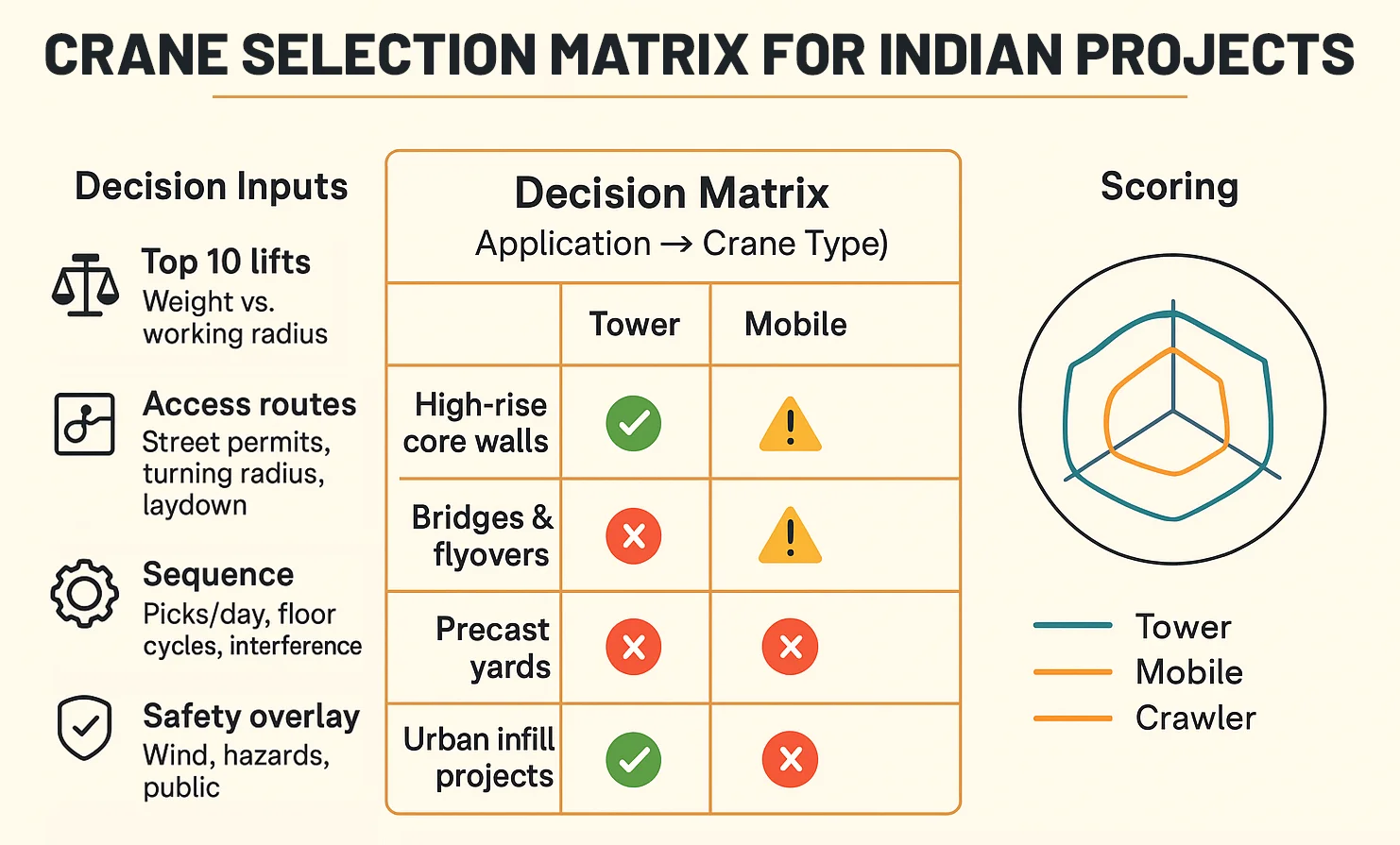
This workflow narrows the field fast while protecting your schedule and margins.
A used crane for sale can be a smart move if you understand the trade-offs.
Talking about mobile crane price India without context confuses teams. Focus the conversation on the levers that move price:
Not just max tonnage, what can it lift at your radius?
Axle count, permits, and transport escorts can add hidden costs.
Outrigger pad size, counterweight handling, and crew needs.
Modern SLI, cameras, and telematics speed up cycles and reduce risk.
Local service network, parts availability, and AMC terms.
Use these to compare offers apples-to-apples when you buy crane solutions for multi-site operations.
Shortlist a tower crane for sale with the right jib length for setback zones, and integrate ACD if you have adjacent cranes or nearby structures. Luffing-jib models help where oversailing rights are limited.
Consider high-capacity mobile cranes for rapid deployment between sites. If picks are heavier and ground is uneven, bring a crawler crane for sale into the conversation.
Whichever machine you choose, model wind profiles into your SLI configuration. For tower cranes, pick models with wind-down procedures and robust mast/tie-in strategies.

Modern B2B buyers don’t separate productivity from safety; they work together. Spec SLI to give operators real-time load, radius, and angle data; pair with ACD to eliminate dangerous slew conflicts in congested sites. These systems reduce incidents, help with insurance, and often accelerate client approvals. If you’re evaluating a used crane for sale, verify that SLI hardware is current and calibrated; factor upgrades into your numbers.
Whether it’s a tower crane for sale, crawler crane for sale, or a road-ready mobile unit, your board cares about lifecycle economics:
Build your case with a five-line TCO model. You’ll avoid false economies and defend your choice when procurement challenges the shortlist.
This is the cleanest path from research to a defensible purchase decision that keeps projects on schedule.
A tower crane for sale with the right radius and tie-in plan typically delivers the best cycle time and site efficiency.
When you need heavy picks on soft or uneven ground, or the ability to travel with a load, start with a crawler crane for sale.
Capacity at your working radius, road permits, setup time, and the level of SLI/telematics.
Yes, if it passes structural/mechanical inspection and you budget for SLI/ACD upgrades and calibration
The smartest cranes for construction decisions are part engineering, part logistics, and part safety planning. Match the machine to your real lifts and radii, insist on modern SLI and where relevant, ACD, and compare full lifecycle costs instead of headline prices. Do that, and you’ll bid stronger, deliver faster, and reduce risk across the board.
If you’d like a tailored shortlist for your next project including model recommendations, mobile crane price India budget ranges, and on-site commissioning reach out to Orange Machine Tech. Our engineers help teams buy crane solutions that perform from day one.
Contact Now